August 27, 2002 marked the end of an era for both fans of
General Motors and muscle
car enthusiasts alike. On that day at the General Motors plant in St. Therese, Canada, the last of the Chevrolet Camaro's rolled off the assembly line. This final red pony car did not just mark the end of a model name, but the end of 35 years of performance tradition. Almost instantly, the public outcry over this decision was heard from enthusiast forums, all the way to international press. This outcry was met with rumors of a new Camaro and pinned to those rumors were sometimes crude drawings of what people hoped or dreamed that this new Camaro would look like, but nothing official was ever issued to support the rumors or artists renderings. It was just over three years from the day of the last Camaro produced when the rumors began flying once again of a new Camaro, and this time, there was some backing from GM about these rumors when they announced that the Chevrolet Camaro Concept would makes its world debut at the 2006 North American International Auto Show in Detroit. Then, on the day before the opening of the Detroit Auto Show, vice chairman of General Motors Bob Lutz drove the silver concept into the display area designated for this new pony car, with hundreds on VIP Camaro enthusiasts on hand as the massive LCD screen backdrop flashed the Camaro name, followed by the current
Chevrolet slogan...An American Revolution. The crowd was hushed by the sound of the 400hp LS2 V8 as it made its way to the platform and although ear plugs were offered, few were used as onlookers stared in awe as the Camaro was finally made official.
| Technical Specs: |
- Corvette-inspired 400-hp LS2 engine
- 6.0L aluminum small block V8
- Six-speed manual transmission with widely spaced ratios for aggressive acceleration and efficient highway cruising.
- Active fuel management designed for impressive fuel efficiency
- Four-wheel vented disc brakes with massive 14-inch brake rotors
- Sophisticated chassis with four-wheel independent suspension and progressive-rate springs.
- Five-spoke cast-aluminum wheels
- 21-inch front, 22-inch rear wheels
- Exposed, high performance brakes
|
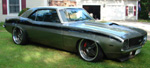
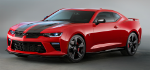
While public outcry may have been a big determining factor in the development of this new Camaro, a modernized return to the muscle car era started by Ford with their very popular 2005 retro-look Mustang and continued by the highly awaited release of the Dodge Challenger concept, proved to GM and the world that it was time to release the car that battled the Mustang and Challenger in the peak of the pony car era. Much like the ultra-retro Mustang and Challenger Concept, the Camaro takes its styling cues from the first generation, which is the most sought after and most popular of the Camaro body styles. The long front hood and fender area and short trunk area are very similar to that of the 1969 style, combined with the popular cowl-induction style hood, the low-laying roof line, and the thin, sinister looking grille help to complete the retro-Camaro look. The flares over the wheels have a thick muscular feel, but unlike the vintage Camaro, the sides of this concept are far more angular which helps to give it a modernized feel. Other current market items that were certainly absent on the vintage models are the "angel eye" style headlight rings, a common item in high end European models such as BMW, which are wrapped around High Intensity Discharge projection headlights. The back end, while preserving the retro-look, also features cues of current day performance cars, such as the 3 inch exhaust which exits through the black rear fascia by means of two massive chrome exhaust tips. Also, unlike the first generation of the Camaro which had long rectangular tail lights, this new Camaro features four separate tail light lenses. While not perfectly round like the second generation Camaro, the new concept has similarly placed and spaced pairs of lenses, and while the new Camaro does not currently have back-up lights, one would be led to believe that if it does come to production as shown at the Auto Show, that it could very well have the back-up light nestled inside two of the tails, also reminiscent of the second generation models.
|
|
 |
The interior of the new Camaro has a full blown futuristic look, and if anything was going to change about this concept before it hits the showroom, it would most likely be the interior. Like the first generation Camaro, the concept features two huge gauges mounted side by side, sunken into the gauge cluster area. The steering wheel also takes minor cues from the past Camaro's with a basic three-spoke design. Aside from the layout of the gauges, and the basic design of the steering wheel, nothing else bares much resemblance to the original. The previously squared off dash is gone, and in its place, an airplane cockpit-like dash wraps around the driver and passenger, and smoothes around to meet the door panels, leading its way down the door to the arm rest/ window switch panels. While much of the interior has bright silver highlights, the concept features a predominantly dark charcoal finish, from the dash to the door panel to the seats to the carpeting. The amount of dark charcoal finish gives the interior a very smooth, blended look, but is set off nicely by the bright silver and neon orange trim. Another feature unlike the 1969 model, is the high sitting center console while serves as both an armrest for the passenger and driver, but also as a housing for the close ratio shifter, where as the original simply had a shifter entering into a floor mounted shift boot. this center console begins behind the front seats, and leads all the way up under the dash, furthering the cockpit look and giving the interior a much more "snug" feel. The race inspired, high back bucket seats provide luxury like comfort, as well excellent support during hard cornering thanks to the steep angle of the seat base, as well as the wrap around sides of the seat back. While the back seat is obviously the back seat of a sports coupe, the elongated wheelbase allows for a bit more leg room than the prior models. Overall, while this new interior may seem a bit too futuristic, it is a awesome mix of form and function.
Aside from the release itself, the biggest news about this great new Camaro, being the LS2 V8 engine, bares both similarities and differences to the classic models. The older model Camaro's were all about huge horsepower and brute torque, and this new LS2 offers 400 horsepower and 400lb-ft of torque. The LS2 is actually a redesigned version of the LS1, which was the engine offered in the last generation of the F-body Camaro. While the LS1 engine has proven to be very healthy and very potent in the Firebird, Camaro, and
Corvette in the late 1990s and early 2000s. But with the steady increase in engine technology, General Motors engineers have introduced the LS2. This LS2 offers an increase of three tenths of a liter to 6.0 over the 5.7 liter LS1, bringing the engine size to 364 cubic inches. While the increase in size helps to yield more horsepower, the bump in size is not the only feature of the Camaro that helps this LS2 force out 400 horsepower. The aluminum engine block has been redesigned to allow for the increase in size by revising the oil galleries and water jackets for proper cooling and oiling, as well as alterations made to the block to allow for externally mounted, thus more serviceable knock sensors. Flat top pistons have been introduced, increasing the compression rate to a steep 10.9 to 1, and the ring tension has been lowered reduce friction. Coupled with that newly reduced heat, the horsepower eating water pump has been redesigned, with a lower internal mass, thus taking less effort on the engine’s part to push the coolant through the engine, thus causing less parasitic loss; and at the same time, reducing internal engine heat. Air is drawn into this new LS2 engine by means of a huge new throttle body. This throttle body measures 90 millimeters, roughly 3.5 inches, and controls the air with the use of a single blade design. Fuel is introduced into the engine by means of the LS2’s sequential port injection system. The camshaft, which controls the valves, has an increased valve lift to allow for greater air and fuel intake to the aluminum cylinder heads which have been redesigned to allow for a smoother flow of the combustion ingredients into the combustion chamber. Along with the increased camshaft lift and increased cylinder head flow, comes a larger power band for this new LS2, and to make sure that every bit of that power band is being used the rpm limiter has been moved up to 6500 rpm from the 6000 rpm limited on the
LS1 Camaro. That rpm limited is incorporated into the revised high performance engine control unit, which controls all throttle and ignition function, with the help of the new increased efficiency ignition coils which draw less energy to provide the same amount of spark on the LS1. So, this awesome car packs awesome power, but with the constantly rising cost of gasoline many sports cars enthusiasts have began to shy from the gas-guzzling V8s, but the design team of the Camaro Concept has taken that into consideration, and thanks to General Motors new Active Fuel Management system, this Camaro gets an amazing 30 miles per gallon during highway driving! Bolted up to this new LS2 is the six-speed manual T56 transmission which offers a close ratio gearing for excellent low end acceleration as well as a low 6th gear, which helps to bolster the top speed, as well as the fuel efficiency.
While the Camaro concept may take its styling cues from the original, the drive train and structural assembly is completely different. The most obvious difference to the untrained eye is the addition of huge 21 inch wheels in the front and 22 inch wheels in the back, which are wrapped in 275/30 and 305/30 Goodyear tires, respectively. The new car may bare the Camaro name, but unlike the 1967-2002 Camaro's, this is not a General Motors "F-Body". The new Camaro is to utilize the new GM Zeta Platform, along with the 2008 Pontiac GTO, and the Holden Commodore in Australia, and this new platform has the Camaro concept sitting 7.3 inches shorter, 5.5 inches wider, and 1.2 inches taller, while offering a wheelbase 9.4 inches longer and a track over 63 inches wide, helping to give this new Camaro a nice wide, low feel for excellent handling and control under spirited romps. To further help this new Camaro handle the turns, and power of the 400 horsepower LS2, the new Camaro features MacPherson strut with progressive rate coil springs in the front and progressive rate coil springs combined with multilink independent rear suspension as opposed to the solid rear axle of the original model. The 1969 Camaro Z/28 came equipped with 15" Rallye wheels, but this new Camaro actually comes with huge 15" brake rotors. These rotors are cross drilled and slotted which helps to quickly disperse heat under hard braking, preventing warping and increasing braking efficiency. Also, the aluminum calipers wrapped around the 15" brake rotors in the front and rear are packed with 4 pistons per caliper, as opposed to the single piston front calipers, and rear drum brakes, in the vintage Camaro Z-28. This new suspension, chassis, and braking assembly insures that this new Camaro can hit the road course just as hard as it can hit the quarter mile, and be at the head of its class on both surfaces.
 |
|
The American Performance market was shaken up when the announcement was made that one of the great American pony cars was being done away with, but in the 4 years of absence, the designers at General Motors have shown that patience is a virtue, and for those who have had the patience to wait for a new Camaro, that virtue will be rewarded with a muscle car for the 21st century, which is one of the slogans emblazed on the huge LCD screen behind the Camaro at the NAIAS. If the many interviews with GM vice-chairman Bob Lutz prove to be true, this new Camaro could hit showroom floors within the next two years, and with a base model price of around $20,000, GM expects sales of this gorgeous new Camaro to equal those of the first generation Camaro. Even with the higher price of the LS2 equipped models, the brute performance of this new muscle car, combined with the modern technology applied to the interior and handling capabilities, this Camaro should surely satisfy everyone who was disappointed to see the end of the Camaro model line in 2002. 2008 could mark a historic year in the American Performance market with the expected release of the Camaro, and the Dodge Challenger, along with the continued production of the Ford Mustang, the pony car race of the 1960s will be alive and well, and the Camaro will more than hold its own among the heavy hitters, just like it was in the late '60s.